
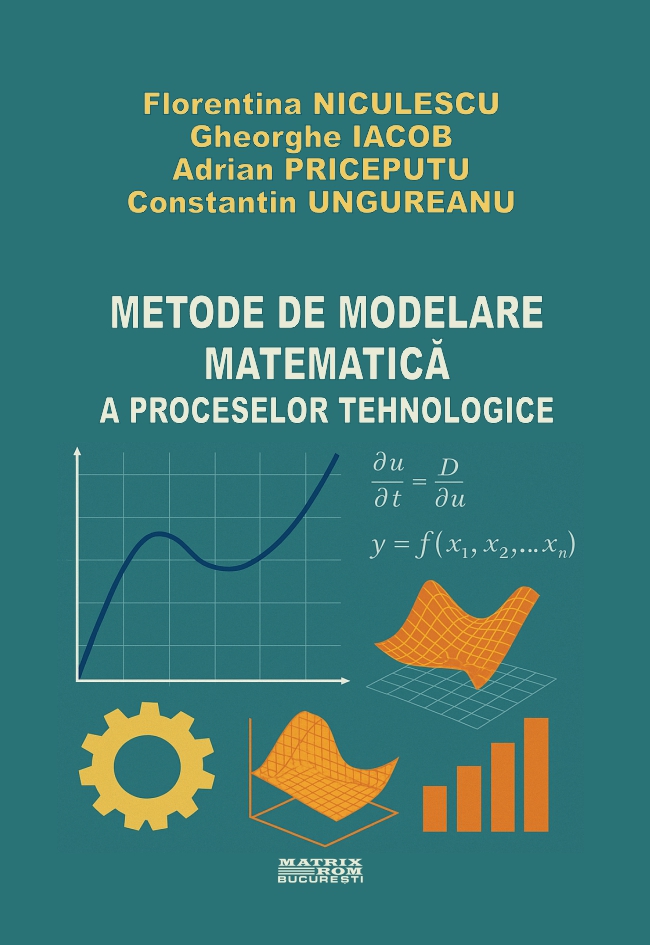
Methods of mathematical modeling of technological processes
Universitatea Politehnica Bucuresti
ISBN: 978-606-25-0981-1
Limba: Română
Suport: Hârtie
This book aims to provide a theoretical and applied framework for understanding and organizing scientific experiments, in a rigorous and mathematically grounded manner. The main goal is to provide the reader with a set of concepts, methods and models that allow the design, conduct and correct interpretation of experiments, especially in the technical and technological field.
In an elegant way, the book moves from the general level of experimental theory to specialized applications, such as the thermodynamic study of solutions. Both theoretical and empirical models are presented, useful for the research of complex chemical systems, thus emphasizing the interdisciplinary usefulness of the proposed approach. Overall, this work represents a complete and in-depth guide for anyone interested in rigorously conducted scientific experiments. It manages to combine the demands of mathematical theory with the practical needs of applied research, providing both a solid conceptual foundation and examples of efficient implementation. It is a valuable tool for both students and researchers, as well as for industry specialists who want to scientifically substantiate the technological processes they develop or analyze.
Related products


Elements of set theory
136,00 lei
