
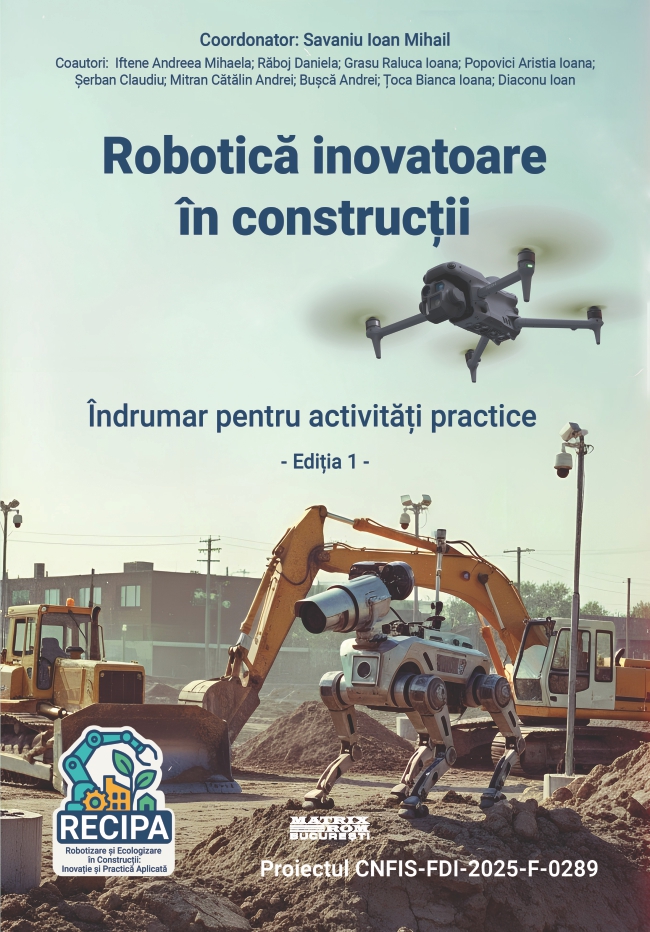
Innovative Robotics in Construction – A Guide to Practical Activities
Universitatea Tehnica de Construcții București
ISBN: 978-606-25-1022-0
Limba: Română
Suport: Hârtie
The guide brings together a series of practical activities that simulate real construction site scenarios using current robotic equipment and platforms: Unitree Go2 quadruped robots for transport and inspection, autonomous mobile platforms with LiDAR and micro-ROS for navigation in complex environments, the Arduino Braccio robotic arm for object manipulation and pick & place operations, and HuskyLens smart cameras for artificial intelligence applications. These systems are integrated into activities that use modern software ecosystems such as ROS/ROS 2, simulations in Gazebo and algorithms specific to autonomous navigation.
The material aims to train both fundamental technical skills – understanding the architecture of a robot, managing sensors – and applied skills, relevant to the construction field: autonomous movement in an environment with obstacles, intelligent transport of materials, automatic inspection of buildings or machinery, monitoring risk areas and applying AI in checking personal protective equipment.
The lessons are structured so as to reproduce the logic of a real technological flow: defining the construction site process, developing the robotization sheet, analyzing inputs and outputs, identifying resources, risks and safety measures, implementing movement algorithms or analysis, practical testing and evaluating performance. Each activity is accompanied by practical exercises, worksheets and instructions for measuring results, so that students can directly observe the robot's behaviors and understand how technology can support the work on the construction site.


